Create your own report in 2 minutes?
Take photos, AI writes the report. Your first test report is free. See how our AI inspection report software works.


The energy transfer document (energieovernamedocument / document de reprise des énergies) is the official Belgian form on which the outgoing user and the new user of a home jointly record the electricity and gas meter readings on the day of the handover. You fill it in twice, both parties sign, and each sends a copy to their energy supplier. It is not a contract with a supplier, but the proof of who pays for which consumption.
The energy transfer document is one common form issued by the three Belgian energy regulators: the Flemish VREG, Brugel in Brussels and CWaPE in Wallonia. It exists in Dutch and French, and it is the same document everywhere in Belgium. Per meter you record the EAN code, the meter number and the reading on the day of the handover, together with the details of the outgoing customer and the new user.
The document is expressly not a contract with an energy supplier. The new user still has to choose a supplier or take over the existing contract. The form only draws the line: everything before the reading is for the outgoing party, everything after it for the new one.
Whenever the electricity or gas connection changes user:
The natural moment is the day of the move-out inspection or the move-in: you are standing at the meters together anyway, and the readings in the condition report are the same ones that go on the energy transfer document. Do it right away: a reading taken a week later is already a different consumption.
Water is not on this form. The water company has its own moving form.
There are two versions of the document. The classic version suffices for any home without its own production. Anyone with solar panels or another production installation uses the renewable-energy version: it has extra boxes for the injection readings of the digital meter (offtake and injection, day and night each). Pick the wrong version and half of the readings are missing, and the discussion with the supplier comes later anyway.
You fill in the document with a digital meter too. The grid operator's automatic reading takes precedence if the readings were to differ, but the document remains the proof of the date and of who took over.
Not sure who the grid operator is? Each regulator has a lookup page: Fluvius in Flanders, Sibelga in Brussels, and ORES or RESA in Wallonia, depending on the municipality.
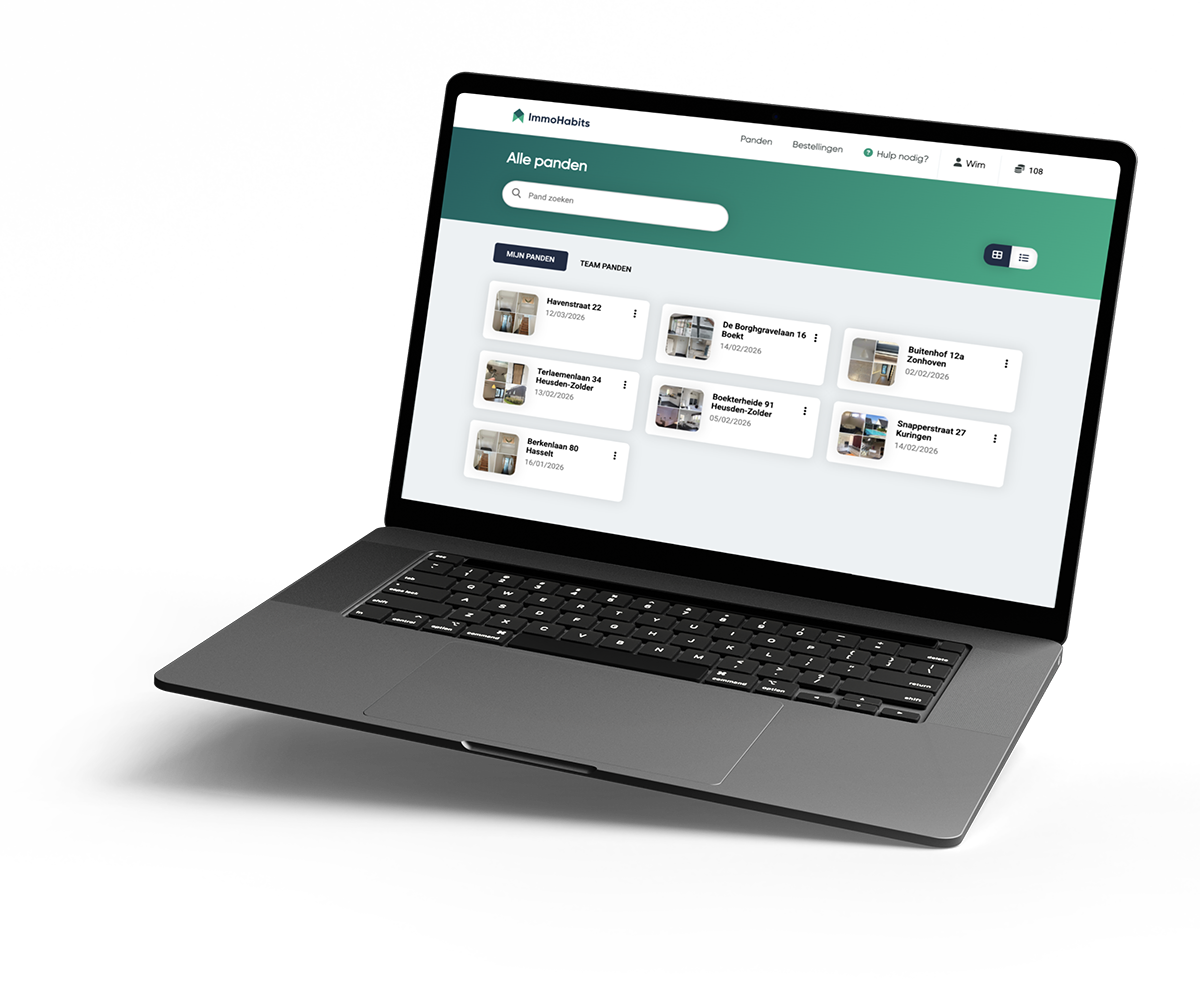
If you work with ImmoHabits, the meter readings, meter numbers and EAN codes are already in the file: they are read from the meter photos during the inspection and shown on the Meter readings tab. From there you create the official energy transfer document in one click, pre-filled with those readings and with the parties from the file. You choose the language (Dutch or French) and the variant (classic or with solar panels), check everything in four steps and download the PDF. It costs no token.
Because the readings come from the same file as the condition report, both documents are guaranteed to carry the same figures. More in the documentation.
Take photos, AI writes the report. Your first test report is free. See how our AI inspection report software works.
Is the energy transfer document mandatory?
No law imposes the form itself, but the meter readings at a handover do have to be recorded to determine who pays what. The official document is the method every supplier and grid operator accepts, and most leases and sale agreements refer to it.
Can it be signed digitally?
Yes. It is a plain PDF, so both parties can sign it digitally, for instance together with the condition report. Make sure each party receives a signed copy.
What if the outgoing party is not present?
Then you fill in the document with the readings of the handover day and have it signed afterwards, or you have the readings recorded by the grid operator or a bailiff. Avoid one-sided documents: without the other party's signature the discussion stays open.
Does it apply to all three Belgian regions?
Yes. It is one common document of VREG, Brugel and CWaPE. Only the language differs: Dutch in Flanders, French in Wallonia, either in Brussels.
Do I also have to do something for the water?
Yes, but with a different form. The water companies each have their own moving form or customer portal.